




Improve Your Sleep With Technology + Lifestyle Habits
Published:
Authors: Therabody Scientists: Tim Roberts, MSc; Kyle Silvey, PhD; Michelle Darian, MS, MPH, RD, LDN; Rachelle Reed, PhD, MS, ACSM-EP
Decades of research show that getting enough quality sleep is critical for overall health. It improves cognition (like memory and concentration), hormone regulation (especially those related to appetite), immune function, performance, recovery, stress, and mood. [1-7]
But despite the vast data showing how quality shut-eye is essential, 35% of U.S. adults do not meet the recommended 7-9 hours of sleep a night. [8] So, there’s a lot of room for improvement.
While it’s up to you to carve out 7-9 hours to be in bed, there’s a lot you can do to set yourself up to get good quality sleep during that time. Here are 8 science-backed tips.
8 science-backed tips to improve your sleep quality
Over 9 million Americans rely on prescription sleep aids to help them snooze. [9] Although these medications can be warranted (and helpful) for certain medical conditions, they shouldn’t be the first-choice solution for everyone. Instead, prioritizing lifestyle factors that can contribute to better sleep can help enhance sleep quality.
Trying to fall asleep while running in circles (physically or mentally) is not the best idea. Instead, focus on four main pillars of an optimal sleep environment: relaxed, cooled, quiet, and dark.
Here are eight science-backed things you can do to fall asleep faster and stay asleep longer, using both simple techniques and the latest tech gadgets.
1. Take a few deep breaths to prepare the body for sleep
Breathing exercises can help you relax and prepare the body for sleep. They does so by switching the body’s nervous system from a state of stress to calm. [10]
A research-backed breathing technique to practice before bed is the 4-7-8 breathing exercise. [11] It follows an inhale, hold, exhale pattern for four, seven, and eight seconds, respectively.
Instructions:
- Inhale for four seconds through the nose
- Pause for seven seconds (at the top of your inhale)
- Exhale slowly (but forcefully) through the mouth for eight seconds with the lips parted, making a whooshing sound
- Repeat
You can do this lying down in bed with your eyes closed to help you fall asleep. Consider starting with five to six cycles. If you want to keep going, take a minute or so break before starting another set. [12]
Additional breathing exercises are available in the Therabody mobile app.

2. Apply gentle vibrations to your eyes and temples to reduce stress
Muscles in the eyes and temples are sensitive to stress and tension building, and a gentle massage can help. Research reveals that gentle, rhythmic movement can promote sleepiness. Similar to techniques used to soothe babies to sleep — like rocking chairs or car rides — vibration-like movements also help adults relax and nod off. Vibrations ease tension in the body, enabling people to not only fall asleep faster but also experience deeper and more restorative sleep overall. [13, 14, 15]
While you can use your fingers or knuckles along your temples, Therabody’s® SmartGoggles harness the power of vibration technology and science-backed routines to eliminate the guesswork and physical work for you. Resembling a sleeping mask, SmartGoggles delivers gentle cyclical vibrations and heat therapy — scientifically proven to improve sleep quality.
While this isn’t a mask you sleep in, you can put it on right before bed while lying down and feel the physical and mental stress melt away.
3. Work out stiff and sore muscles to help physically relax
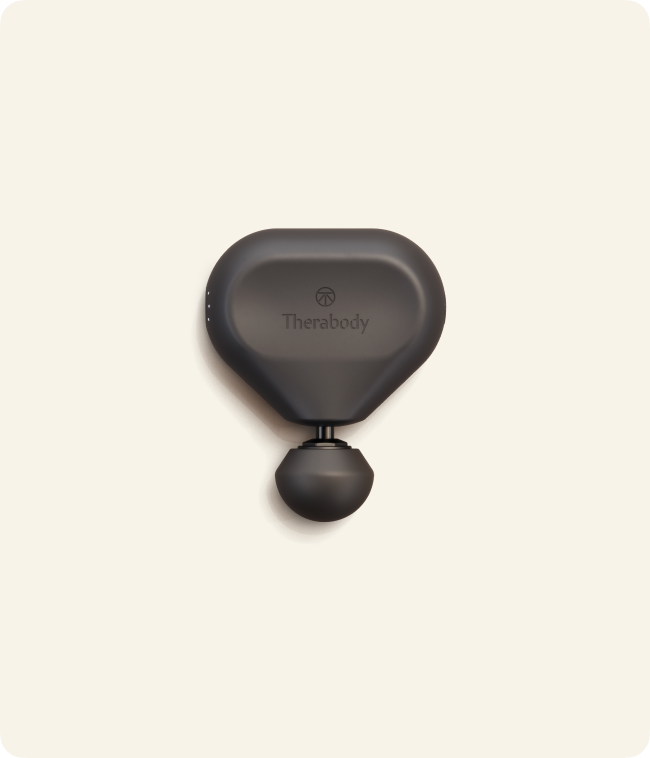
If your body is not physically relaxed, it can hinder your ability to fall asleep. Whether your muscles are tight from stress or the lingering effects of a tough workout, you may benefit from percussive therapy. Percussive therapy delivers rapid, concentrated pulses or vibrations and is the type of treatment that massage guns — like the Theragun — provide.
A study measured the use of the Theragun before bed and showed that it can help improve sleep. Participants only used the Theragun sleep routines for two weeks of the study, but the impact was clear:
- 87% of participants fell asleep faster (on average, 4 minutes and 15 seconds faster each night)
- 70% of participants experience more efficient sleep (and on average woke up 7% less each night)
- Participants reported a 9% and 5% reduction in pain and soreness, respectively

4. Relax restless muscles to prepare for sleep
Another way to help calm restless muscles is to use pneumatic compression. Pneumatic compression is a type of compressive therapy generated by a pump to control the amount of pressure and the intervals at which pressure is delivered to the treatment area (that is cuffed in a sleeve or a boot).
This therapy has decades of data showing its effectiveness for everything from muscle soreness to swelling, but emerging research shows that pneumatic compression before bed may be beneficial for those with restless legs syndrome. [16]
Restless legs syndrome is a neurological disorder that causes an uncomfortable feeling in the legs and an irresistible urge to move them. This intensity increases at night and can severely interfere with sleep quality. It’s estimated that around 7-10% of adults in the U.S. have this condition, which there is currently no cure for. [17]
The sleep benefits of pneumatic compression circle back to the device’s ability to improve blood flow. [18] It’s important to speak with a healthcare provider to determine if pneumatic compression is right for you.

5. Lower the temperature of the room with an air conditioner or fan
It’s hard, if not impossible, to sleep if your room is hot and stale. Research shows that the best temperature for sleeping is around 65 degrees Fahrenheit (or 18.3 degrees Celsius). This may vary a few degrees from person to person, but the maximum recommended sleeping temperature hovers around 70 degrees Fahrenheit. [19]
If you have air conditioning, use it to cool your room down. If it’s a cool evening and it’s safe to do so, opening a window can also help.
Cooling down your body can also work if you don’t have access to an air-cooling option. Cooling devices applied to the skin have also been shown to help improve sleep in hot environments. [20, 21]
6. Listen to relaxing music or white noise
Some people have no problem falling asleep in loud airports or during a blaring movie. But even if you can do that, it doesn’t mean you should. Aim for a quiet room or one with relaxing sounds.
Scientists have explored the physical, biological, and mental effects of various musical elements and audio techniques. Sound therapy can provide benefits like relaxation and stress reduction. It can help you find your “off” button by engaging parts of your brain while letting the ones connected to stress or mental agitation relax. [22] In turn, you fall asleep, stay asleep, and sleep soundly.
When you connect your Theragun Sense to the Therabody App, you uncover relaxing sounds that you can use before bed. Use the massage gun before bed to relax your muscles and tune into your favorite soothing audio track to help lull you to sleep.
7. Avoid screens like TVs, phones, and laptops before bed
Again, some people can fall asleep in rooms with blinding lights or bright screens nearby. However, that can be detrimental to your sleep health in the long run. As difficult as it may be, try to stop screen use at least two hours before bed. Exposure to any light (including blue light) delays melatonin production — the hormone that promotes sleepiness. [23]
Try to stop screen use at least two hours before bed. If that’s not possible, you may want to try wearing blue light glasses, getting an app that filters the light output on your screens, or setting your devices to dim after sunset.
If you can’t avoid blue light altogether before bed, try wearing a pair of blue light glasses, getting an app that filters the light output on your screens, or setting your devices to dim after the sun goes down.

8. Wear an eye mask to bed to block out light
If you don’t feel like replacing the blinds or shades in your room, wearing an eye mask to bed is an effective solution.
Eye masks block out light that can also disrupt melatonin production and misalign your greater circadian rhythm — the 24-hour clock that governs physical, mental, and behavioral changes. [24]
Therabody’s SleepMask is scientifically proven to help you:
- Sleep longer
- Get more deep sleep
- Fall asleep faster
- Wake up feeling better
- Feel less stressed
Keeping your bedroom dark, especially if your sleeping window has you rising after the sun, can help keep you asleep.
Key takeaways
- Sleeping well is crucial for optimal health — but upwards of 35% of adults in the U.S. do not meet the nightly recommended 7-9 hours of sleep per night.
- Prescription sleep aids aren’t a long-term solution. Instead, start by altering your sleep habits and integrating technology into your routine to help get good quality rest.
- Aim to create a relaxing, cool, dark environment to set yourself up for good quality sleep.
- Therabody products provide research-backed therapies (including vibration, percussive, and sound) that can help relax the mind and body — priming you for the best night’s sleep possible.
References:
- Short or long sleep duration is associated with memory impairment in older Chinese: the Guangzhou Biobank Cohort Study
- Short or long sleep duration is associated with memory impairment in older Chinese: the Guangzhou Biobank Cohort Study
- Effects of acute sleep loss on leptin, ghrelin, and adiponectin in adults with healthy weight and obesity: A laboratory study
- Immune, inflammatory and cardiovascular consequences of sleep restriction and recovery
- Association of Sleep Duration, Napping, and Sleep Patterns With Risk of Cardiovascular Diseases: A Nationwide Twin Study
- Sleep duration and risk of all-cause mortality: A flexible, non-linear, meta-regression of 40 prospective cohort studies
- Sleep, Recovery, and Performance in Sports
- Unhealthy Sleep-Related Behaviors
- Prescription sleep aid use among adults: United States, 2005-2010
- How Breath-Control Can Change Your Life: A Systematic Review on Psycho-Physiological Correlates of Slow Breathing
- The Effect of Deep Breathing Exercise and 4-7-8 Breathing Techniques Applied to Patients After Bariatric Surgery on Anxiety and Quality of Life
- Effects of sleep deprivation and 4‐7‐8 breathing control on heart rate variability, blood pressure, blood glucose, and endothelial function in healthy young adults
- Effect of Closed-Loop Vibration Stimulation on Heart Rhythm during Naps
- Weak closed-loop vibrational stimulation improves the depth of slow-wave sleep and declarative memory consolidation
- The Calming Effect of Heartbeat Vibration
- Pneumatic compression devices are an effective therapy for restless legs syndrome: a prospective, randomized, double-blinded, sham-controlled trial
- Restless Legs Syndrome
- A systematic review of pneumatic compression for treatment of chronic venous insufficiency and venous ulcers
- The Temperature Dependence of Sleep
- Local body cooling to improve sleep quality and thermal comfort in a hot environment
- Effects of head cooling on human sleep stages and body temperature
- Systematic review: auditory stimulation and sleep
- Light exposure during sleep impairs cardiometabolic function
- The effects of earplugs and eye masks on sleep quality of patients admitted to coronary care units: A randomised clinical trial


